

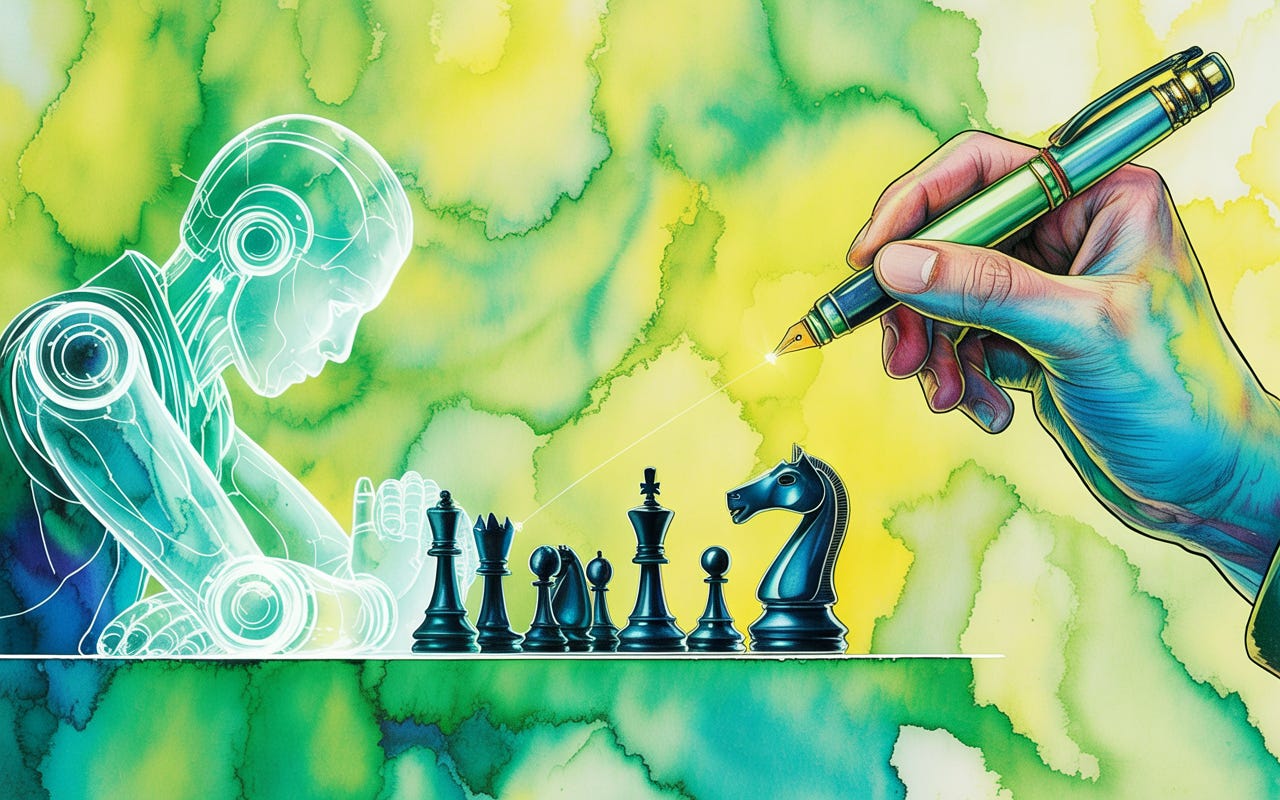
There’s a kind of wealth that doesn’t show up on any balance sheet. You can’t spend it, but it compounds. You can’t lose it in a market crash, but you can let it rot from neglect. It’s the only asset that grows the more you give it away.
It’s what you know, how you think, what you notice, and what you make of all of it.
I call this intellectual capital — and I’ve come to believe that building it deliberately is one of the highest-leverage things a person can do. So I’m starting a newsletter about exactly that.
What this is
Intellectual Capital sits at the intersection of four things I can’t stop thinking about:
Productivity — not the grind-harder kind. The kind that’s really about doing what matters with your full attention and protecting the energy to do it.
Curiosity — the engine underneath everything good. Learning how to learn and giving yourself permission to fall down the right rabbit holes.
Creativity — curiosity put to work. The craft of actually making things and getting past the part where you stare at the blank page.
Ideas — the connective tissue. The frameworks and mental models that let all of the above stack into something durable.
Most newsletters pick one of these. I think the interesting stuff lives in the overlap — where a question you couldn’t shake becomes a thing you build, which changes how you spend your days.
And running through all four, like current through a wire, is the thing reshaping every one of them right now: AI.
On using AI — unabashedly
Let me be clear about where I stand, because it colors everything here.
I use AI constantly, openly, and without apology. Not as a gimmick and not as a crutch — as an amplifier for the four things above. It is the single biggest lever on intellectual capital to come along in my lifetime, and I’m not going to be coy about reaching for it.
The hand-wringing crowd has this backwards. The worry isn’t that AI will think for you. The worry is that you’ll use it to avoid thinking — to outsource the struggle that actually builds the muscle. Those are entirely different things. Used badly, AI makes you duller. Used well, it lets you ask bigger questions, chase more rabbit holes in an afternoon than you used to in a month, and ship things you’d never have finished alone.
The skill — and it is a skill — is knowing which parts to hand off and which parts are the whole point. You don’t let it write the sentence you most need to think through. You do let it kill the blank page, pressure-test your logic, summarize the thing you’d never have read, and play the tireless sparring partner at 2am.
So expect a lot of this newsletter to be about doing exactly that, in the open:
Prompts and workflows that actually move the needle, not party tricks.
Where AI fails — the tasks where reaching for it costs you more than it gives.
Taste over output — how to stay the editor, the curator, the one with the point of view, when generating a thousand words costs nothing.
Building intellectual capital in 2026 without using AI well is like doing arithmetic by hand to prove a point. Admirable, maybe. But you’re leaving the compounding on the table.
What you’ll actually get
Every issue is built to respect your attention because that’s the whole point. In most issues, you’ll get:
One big idea worth chewing on — drawn from one of the four themes above.
One thing to try this week — concrete, not theoretical. Often an AI workflow you can steal in five minutes.
A few things worth your curiosity — links, quotes, and objects I think are worth your time, each with a reason.
A few minutes out of your day, then I get out of your way. No hustle-porn, no link dumps, no manufactured urgency.
Every so often, though, I’ll break the format. When a topic deserves room to breathe, you’ll get a longer-form piece instead — a deep dive into a single idea, a how-to I’ve actually stress-tested (think “10 Ways to Level Up Your AI-Assisted Work”), or an opinion piece I couldn’t fit into a few hundred words. Those will take more than a few minutes. They’ll be worth it.
Why I’m writing it
Honestly? Partly selfish. Writing forces me to actually finish a thought instead of letting it dissolve back into the noise. The best way I know to build intellectual capital is to put ideas into the world and see which ones survive contact with other people.
But also: I think a lot of us feel stretched thin and weirdly dull at the same time — busy without being curious, productive without making anything. I don’t think that’s a personal failing. I think it’s what happens by default, and it takes a little deliberate practice to climb out of. This newsletter is me doing that practice in public and inviting you to do it alongside me.
One thing to try this week
Keep a “spark file.” A single note — on your phone, in a notebook, wherever — where you write down every question that genuinely interests you. Don’t answer them. Don’t organize them. Just catch them before they evaporate.
In a month, read it back. The patterns in what you’re curious about will tell you more about where to point your time than any productivity system ever will.
Come along
If any of this resonates, the best thing you can do is reply and tell me what you’re curious about right now. I read everything, and your answers will shape where this goes.
Thanks for being here at the start.