

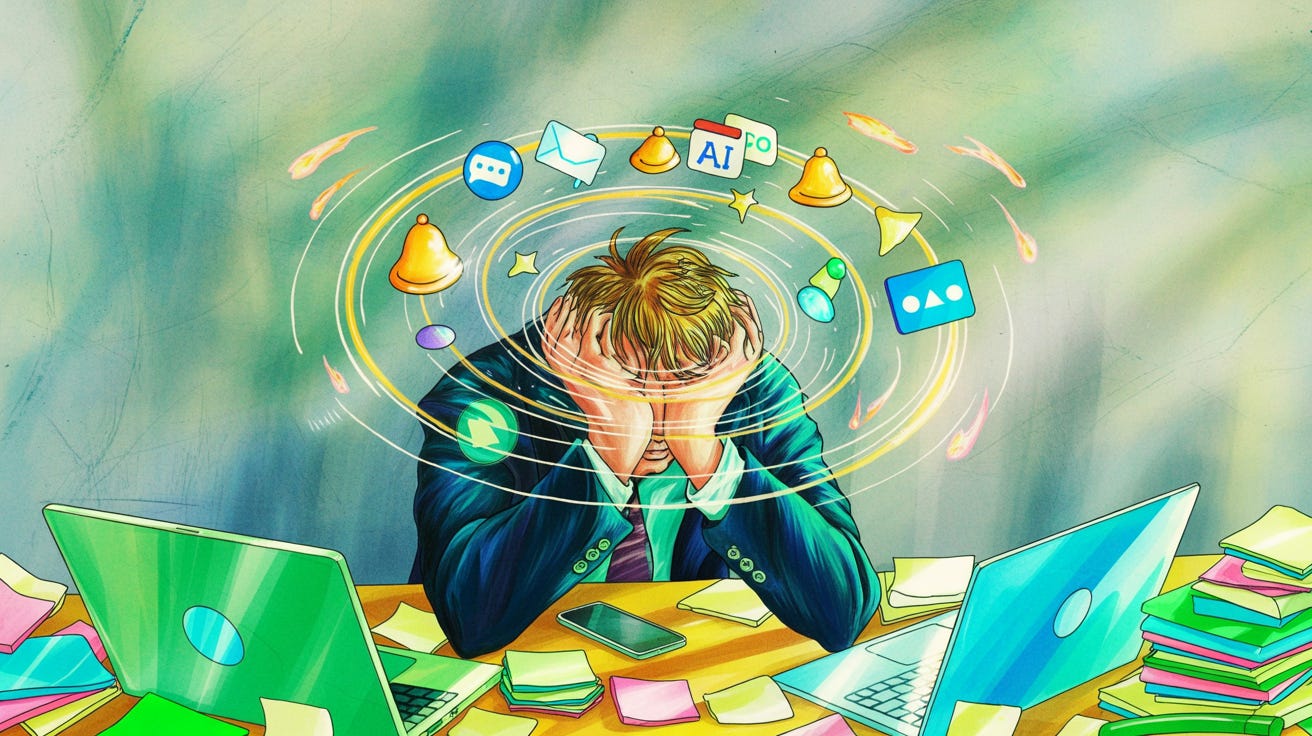
Modern work happens in an environment built for interruption. Notifications surface all day, priorities shift before the first coffee is finished, meetings multiply, and every device competes for your attention. Staying focused under those conditions can feel like swimming against a tide while someone keeps throwing beach balls at your head. The reassuring part is that the difficulty is mostly situational rather than personal, and a set of tested, practical habits can pull focus back. None of what follows is theory dressed up as advice; it’s a working toolbox, assembled over a decade of software work and years of trial and error, that you can borrow from as heavily or as lightly as suits you.
Why attention has become so scarce
Before reaching for tools, it helps to understand why attention has become so scarce. Compared with thirty or forty years ago, the world has grown vastly more complicated, and it has done so at a speed our biology never anticipated. Life before the smartphone was simpler: walking the dog meant walking the dog, not also being reachable by everyone at once. We now absorb information at a volume and pace never seen before, and even ordinary decisions have multiplied, with twenty or thirty kinds of cereal on a shelf that once held three. There’s nothing wrong with us. The human brain is roughly a fifty-thousand-year-old piece of equipment, and it simply hasn’t kept pace with the environment it now has to operate in.
How focus works in the brain
That mismatch shows up most clearly in how focus actually works. We tend to imagine attention as a switch we can flip on demand, but it behaves more like a balance among competing systems in the brain. Four of them do most of the work. The prefrontal cortex acts as the chief executive: it handles planning, decision-making, and impulse control. The anterior cingulate cortex serves as a traffic controller, helping you move between tasks and judge which ones are worth switching for. The striatum is the reward center, dispensing dopamine — a chemical messenger tied to motivation and pleasure — each time you tick something off a list or ship a piece of code. The amygdala is the alarm system, and it’s the one to watch, because under moderate but prolonged stress it floods the brain with cortisol, a stress hormone that, given enough time, lets the amygdala seize control away from the prefrontal cortex. As that happens, your capacity for planning, judgment, and self-control steadily erodes.
The cost of every interruption
The practical cost of this design becomes obvious the moment you’re interrupted. Your best work happens in a state of deep focus, and the trouble with the current environment is how little uninterrupted time it allows. Picture working on a detailed report. A tap on the shoulder or a single email notification is enough to scatter that fragile mental model, and rebuilding it afterward is largely from-scratch work. Everything the prefrontal cortex does is expensive in literal terms (oxygen, glucose) which is why it tires quickly and why a day of constant switching can leave the brain with nothing left to give. The sensation of being context-switched to death is not a metaphor so much as a description of depleted fuel.
How AI intensifies the problem
Artificial intelligence, for all it promises, tends to intensify this rather than relieve it. The pitch is more output in less time, but the output still has to be read, validated, and often re-prompted, and reviewing work you didn’t write yourself is itself cognitively demanding. There’s also a tempting failure mode in which you set one agent — an AI system working semi-autonomously on a task — running on one problem, then a second on another, then a third, multiplying context switches far beyond anything a single human workflow would generate. Layer rising expectations on top, where everyone is now meant to deliver more, faster, at the same quality, and you arrive at AI burnout, which has become a real and named phenomenon. Since rolling back decades of progress isn’t an option, the only durable answer is to find ways of working that keep human beings from burning out while still getting things done.
Manage your time
The most basic of those ways is deliberate time management. Blocking focus time on a calendar so it’s formally scheduled is a sturdy starting point; ninety minutes three times a week works well as a default, and you can stretch or shrink it to fit your own rhythm. Code reviews deserve their own protected slots, because they’ve become a genuine bottleneck: a colleague’s task can stall for two days while their review sits in your queue, and batching reviews twice a day — first thing in the morning when mental energy is highest, and again after lunch — keeps that work moving without forcing anyone to review code for hours on end. The companion technique is what you might call ramping in and ramping out: rather than slamming from deep focus straight into a meeting, you give the brain five or ten minutes to make the switch gently, leaving yourself a breadcrumb or even a deliberately broken line of code so that when you return, you instantly recall where you were. The same easing applies at the start and end of the day, around lunch, and between tasks, and after enough practice it becomes instinct, formally blocked on the calendar only when the day is unusually crowded.
Manage your energy
Managing time is one lever; managing energy is the other, and for that the traffic-light method earns its place. The aim is to recharge before you’ve run yourself completely dry. For a week or two you write down each task as you do it and sort it into one of three buckets — draining (red), neutral (yellow), and energizing (green) — then look at the pattern. Some days will tilt heavily red, which is simply life, but if half your time consistently lands in the red, that’s a signal to act: hand a task off, find a less draining way to approach it, or deliberately thread small green tasks between the red ones so your battery recharges steadily instead of bottoming out. Tracking your personal time the same way gives you a second source of balance, so that a stretch of unavoidable red at work can be offset by green at home. The goal isn’t to hit precise percentages every day; it’s to keep the overall balance from collapsing.
Clear your space and your screen
Your physical surroundings feed into the same energy budget. Visual clutter in your workspace quietly taxes the brain whether or not you notice it, and so does a desk that faces a corridor where people stream past all day. The fix isn’t to become spotless overnight but to remove what you can from your direct line of sight — into a drawer, off to the side, anywhere out of immediate view. For anyone working from home, the couch is a particular trap; carving out even a small dedicated zone, a rug with a desk and a chair and nothing else, trains the brain to associate that spot with work and the rest of the home with rest. It sounds almost too simple to matter, yet stepping into a defined work space and out of it again does a surprising amount to mark the boundary between focus and free time.
The same principle of reducing clutter applies to the screen, where open browser tabs tend to breed. By the end of a day it’s easy to have several windows crammed with tabs you can no longer even read, so that finding anything costs five minutes and sometimes you forget what you were looking for in the first place. Two rules tame this: if you don’t need a tab right now, close it; if you do, drop it into a tab group — a labeled cluster of related tabs, also called tab stacks or tab islands depending on the browser. Grouping tabs by task makes moving between tasks far easier, and in browsers like Chrome the groups persist after you shut the laptop down, so if a production outage forces you to drop everything and help elsewhere, you can later return to exactly where you left off.
Get started on hard tasks
Even with the environment in order, some tasks resist starting simply because they loom too large, like a mountain you’d rather not begin to climb. One well-worn answer is to eat the frog: identify the hardest, most unpleasant task of the day and do it first, while your mental bandwidth is at its peak. Because we reliably underestimate how long things take — the one-hour frog is usually ninety minutes — front-loading it also leaves room for everything else. When the frog turns out to be a month-long refactor rather than a morning’s work, the real first task is to turn one big frog into several smaller ones, breaking it down until a piece of it is startable. On days when even that fails, the snowball method helps: knocking out a few small, easy items earns each its little hit of dopamine, and since dopamine builds motivation, that momentum can carry you into the larger task you’d been avoiding. And when starting is the entire battle, a timer is remarkably effective; you tell yourself you only have to work for five minutes, which is easy to agree to, and more often than not you simply keep going once you’ve begun. Preparing the slides behind this very material started as a two-hour timer on a free Sunday and turned into five hours of unbroken flow, which is exactly the point: the obstacle was beginning, not doing.
Work with procrastination, not against it
Procrastination deserves a closer look, because we usually misdiagnose it. We treat it as laziness or weak willpower and tell ourselves to grow a spine, but it has little to do with willpower. What’s really happening is that the brain is trying to protect you from an unpleasant feeling — boredom, anxiety, fear of failure — by steering you toward something more comfortable. It means well; it just isn’t helpful. The first counter-strategy is to make the escape route as hard to take as possible: if you procrastinate by color-sorting Lego, move the Lego out of the office; if the phone is the culprit, keep it somewhere you have to physically get up to reach. When the distraction was news sites, developer blogs, and social feeds, willpower did nothing, so the answer was a website blocker — Cold Turkey, a tool that’s simple to install and deliberately hard to bypass — which after a few years had quietly retired the habit it was built to stop.
When you can’t simply remove the temptation, the second strategy is to make the task you’re avoiding more pleasant: put on music you love, make a favorite drink, turn the work into a small game. Most important, celebrate whatever progress you make, even if it’s nothing more than opening the codebase in your editor, because that’s still further along than you were a moment ago. The third strategy works on the level of thought itself. We tend to attach negative labels to tasks we dislike, and phrasing a task negatively actually raises cortisol, which weakens impulse control; repeated often enough, that aversion hardens into a habit, and habits fire before the prefrontal cortex can intervene. The remedy is to catch the moment and reframe it — telling yourself that reviewing an AI-written pull request will sharpen your reviewing skills, for instance. It feels absurd at first, but the brain is adaptable, and consistently thinking better of a task will gradually rewrite the habit, until those tasks stop registering as threats and become far easier to begin.
Survive meetings
Meetings are their own particular ordeal, because they demand sitting still for long stretches while somehow absorbing what’s said, and most of us leave them more drained than when we arrived. The strategies that help aren’t about becoming a star participant; they’re about getting out the other side less exhausted. Start by stripping away distractions: if you don’t need your phone or laptop in the room, leave them out, at least where you have the choice. Then work to keep your brain in an active rather than passive listening state, because passive attention tends to drift after five or ten minutes into daydreams about pancakes and grocery lists. Asking a few genuine questions — three or four across an hour, not a barrage — forces you to process what you’re hearing, and taking notes by hand, especially rephrasing the content in your own words rather than copying the slides, triggers the same effect. For listen-only meetings where questions aren’t possible, a little gamification does the trick: a long-running contest with colleagues over who could collect the most stars each time someone said the word “agile,” with a candy bar as the prize, sounds ridiculous but genuinely keeps you listening. Keeping your hands busy in any small way, a fidget toy or a squishy ball or even quiet knitting on a video call where no one can tell, helps you take in what’s being said.
Stop storing everything in your head
Once focus, energy, and meetings are reasonably under control, the next move is to stop using working memory as a storage device for everything you have to do. Working memory is precious, and it should be reserved for the thinking you actually want to spend it on. The simplest way to offload is a to-do list, which sounds trivial but is genuinely powerful; the specific tool barely matters — ClickUp and Todoist both work well, and a free tier or a sheet of paper is plenty — so long as the things you need to do live somewhere outside your head, where you won’t forget them and your brain can stop spending energy tracking them. The companion tool is a prioritization matrix, useful because deciding what matters most gets hard under stress, especially in cultures where everything is urgent and asking someone to prioritize just gets you “all of it.” The Eisenhower matrix, which sorts tasks by urgency against importance, cuts through this on a whiteboard at home or a scrap of paper at work, forcing you to weigh tasks against one another and exposing the things that feel urgent but aren’t. Naming your real priorities frees the brain from running its anxious background process of trying to keep track of them all.
Tame the smartphone
That leaves the hardest case of all, the smartphone, which has a fair claim to being a weapon of mass distraction. Three forces make it so difficult to put down. The first is what you might call the magical maybe: because notifications arrive on no fixed schedule, the phone behaves like a slot machine, and after a while it’s the anticipation of a notification, not the notification itself, that releases dopamine, leaving the brain running a constant background check on whether something’s happening. Studies bear this out — put a group’s phones in a box across the room, and people keep spending mental energy monitoring for alerts simply because the devices are present. The second force is the cost of the switch itself: every time an alert pulls you over to reply, your brain performs another expensive task switch, and doing this all day drains resources you’d rather spend elsewhere. The third is habit, captured in the saying that neurons which fire together wire together; once your brain links picking up the phone to a feeling like boredom, the action runs automatically, before the prefrontal cortex can object, so you find yourself holding the phone again having resolved minutes earlier to use it less.
The countermeasures escalate in proportion to how much trouble you’re in. The obvious first step, which helps far more than it seems it should, is to turn off nearly all notifications — banners, vibrations, sounds — leaving only the genuinely important ones, like calls from your mother. Most things can wait an hour or two without the world ending, and once the alerts go quiet, the brain’s constant background check begins to ease and the pull weakens. Beyond that lies deliberate screen-free time, enforced rather than willed: a drawer isn’t enough, since the brain will retrieve the phone before you’ve registered the decision, so the stronger move is a lockable box that holds the phone, the laptop, the game controllers, the TV remote, and anything else used for distraction, sealed away for an hour. The first week of this can be genuinely awful, a near crawling-out-of-your-skin discomfort that leaves you wandering the apartment unable to settle, even drifting into the room where the locked box sits without knowing why. It eases after that first week, and after about six months the box becomes unnecessary, the phone manageable in a mere drawer, with the full lockdown reserved for moments when the device starts to feel like it’s running you.
Keeping the phone physically distant matters as much as locking it away. Moving it out of the bedroom, or at least off the bedside table and into a holder by the door where it can still charge and serve as an alarm, removes it from arm’s reach; the result was trading thirty to sixty minutes of nightly aimless googling for half an hour of reading, and a marked improvement in sleep quality that feeds straight back into focus. The same out-of-reach principle works at the desk during the day. And because most of us still need the phone for real tasks, a friction app earns its keep — one that either blocks specific apps or inserts enough resistance that an automatic habit becomes a conscious choice. One Sec is a strong example: opening a chosen app first triggers a “take a deep breath” pause of about eight seconds, then asks whether you really want to open it, and if you do, makes you commit to a time limit, capped at fifteen minutes, after which it stops you and asks again. Chrome usage that had quietly reached three hours a day, a genuinely shocking number for someone who assumed they were disciplined, fell to roughly forty-five minutes through friction alone, freeing more than two hours daily and restoring a real sense of control.
Expect to fail, and keep living
Whatever you take from all this, expect to fail at some point, because this is hard; entire libraries exist on the subject for good reason, and AI and the smartphone have only raised the difficulty. Failure is just information. Get back to it, adjust what you’re doing to fit how you actually function, and try again. It’s worth remembering, too, that the people who seem effortlessly productive and perpetually focused aren’t; we’re human beings rather than robots, and the state of the world, the shape of our tasks, and what’s happening with our families all bear on how effective we can be on any given day. If small children have woken you five times a night for two months, no productivity app will save you, and that’s fine. Nobody has to be fully productive every single day.
If there’s a single thing worth holding onto, it’s this: hack your own life. If you want to change or improve something, be inventive about it and find the path that fits you. Take exercise, which is good for focus and health and yet, for someone who finds the gym unbearably boring and quits every sport within a few months, a chore reliably abandoned. The fix was to connect exercise to something already enjoyed consistently — gaming — by buying a foldable exercise bike that tucks under the couch, and now an hour on the bike five or six times a week, played alongside a video game, requires no willpower at all because it’s genuinely fun. It’s an embarrassingly simple solution, overlooked for years only because exercise was assumed to mean going somewhere specific. So be creative, try different things, and keep what works for you.
The last word is a caution against the whole enterprise tipping over into excess. Go outside, relax, and actually live your life, because a life isn’t meant to be optimized to death and you’re not meant to be productive every waking second. Leave room for the things that make you happy, including the ones that look like a waste of time, whether that’s building Lego in the basement or sorting a pen collection by color. Keeping up with this industry, especially now, is close to a full-time job on its own, so the discipline that matters most in the end is making sure you still take the time to live.